

TL;DR: In eight days, Nvidia lost the only CEO it ever had, and Washington rewrote the rules on who can use American AI chips. The new rule goes after a quieter channel: renting the compute instead of shipping the chips. And Brazil, a Latin American country, made the list.
What happened
It started as a tabloid story and ended as a national security rule. A New York Times investigation reported that Jensen Huang had a close relationship with Alice Huang (no relation), a former executive at Singapore-based cloud company Megaspeed, whom U.S. intelligence reportedly believes was gathering information for Beijing. Those intelligence claims rest on anonymous sources and have not been publicly proven.
The money trail is the part that matters for policy. According to the Times, Megaspeed's Malaysian sister company bought at least $4.8 billion of AI equipment containing Nvidia chips between June 2024 and February 2026, and a Commerce investigation into the company has been handed to the Justice Department. Records reported by the WSJ put the figure higher, at about $12 billion in top Nvidia chips routed to China in 2024 and 2025. Megaspeed denies sending chips to China.
How the week unfolded:
Nov 8: Huang admits the affair; Nvidia's board opens an independent investigation (TweakTown)
Nov 10: Senators Warren and Banks push their AI Overwatch Act (Al Jazeera)
Nov 12: Huang resigns as CEO and board member; CFO Colette Kress becomes interim CEO (Nvidia 8-K)
Nov 13: New research shows China's most advanced AI models were trained on export-banned Nvidia chips (TechCrunch)
Nov 16: Commerce issues an interim final rule closing the remote-access loophole and adding five countries to its license list (Bloomberg)
This morning, the Bureau of Industry and Security (BIS) published the rule. In its own words, it is designed to ensure that existing restrictions cannot be circumvented through remote computing arrangements in third countries.
The issue, explained
Export controls were built for boxes. For years, Washington's strategy was simple to describe: the most advanced chips, like Nvidia's Blackwell line, can't be shipped to China or to Chinese-owned firms. Control the shipment, control the capability.
The cloud broke that logic. A Chinese company doesn't need a GPU in Shenzhen to train a model. It can rent the computing power from a data center in Singapore or Kuala Lumpur, log in remotely, and the chip never crosses a Chinese border. On paper, nothing was exported to China. In practice, China got the compute.
Today's rule extends controls from the chip shipment to how the compute is used. It does three main things:
Licenses compute, wherever it sits. Any data center in the world that provides more than 12 million TPP (total processing performance) to companies headquartered in China, Macau, or other restricted countries now requires a license to operate. That threshold equals roughly 758 H100s, or 222 of the newest B300s, and it counts across linked sites, so splitting a cluster across buildings doesn't reset the meter.
Adds five countries to the license list. Exports, re-exports, and transfers of advanced chips to or within Indonesia, Malaysia, Singapore, Thailand, and Brazil now require a license, reviewed on a case-by-case basis based on how well each country enforces controls.
Carves out U.S. companies, with paperwork. Shipments to U.S.-headquartered end users are exempt from the five-country license only if the exporter files monthly reports listing every party, product and quantity. Companies headquartered in Europe, Japan or India get no such exemption.
Data centers already serving Chinese clients have 90 days to get a license. The rule also formally rescinds the Biden-era AI Diffusion Rule and its country tiers, and Commerce says it was written at the direction of Treasury and the National Security Council.
By the numbers
~2 million: advanced chips that entered China in 2024 and 2025 through schemes hiding their final destination, an estimate (Epoch AI, via TechCrunch)
~600,000: H200 chips sitting in Hong Kong as of Nov 5, awaiting approval for shipment to mainland China (Reuters, via Benzinga)
~$12 billion: top Nvidia chips Megaspeed arranged to ship to China, 2024 to 2025 (WSJ, via investingLive)
~90%: Nvidia's estimated share of the market for high-powered AI data center GPUs (Fortune)
12 million TPP: the new license threshold for compute provided to China-headquartered firms, about 758 H100s (BERI)
33 years: how long Huang ran Nvidia before resigning (CMSWire)
Why it matters
Under the new rule, a data center’s compliance depends on who logs in, regardless of where the chips are installed.
Photo by Erik McLean on Unsplash.
Data centers just became border crossings. Until today, a data center operator in Singapore mostly worried about power, cooling, and uptime. Now it has to know who its customers' ultimate parent companies are, add up their compute across buildings, and answer to a U.S. licensing office. Know-your-customer, a concept borrowed from banking, is now an export control. The physical location of the chip matters less than who is allowed to log in.
One relationship exposed a whole supply chain. Nvidia's dominance means that a single company's sales decisions shape who gets access to frontier compute worldwide. The Huang scandal showed how thin the line between a cloud partner and a diversion channel can be. Whatever the investigation concludes about Alice Huang, the policy problem was already visible: some reports tie her to a web of Chinese companies that used her closeness to Huang to reach billions of dollars in GPUs.
Latin America is now on the map. Brazil sits on the same list as four Southeast Asian hubs. Commerce hasn't said why, and BIS will review licenses based on how well each country enforces export controls. That criterion is the one to watch.
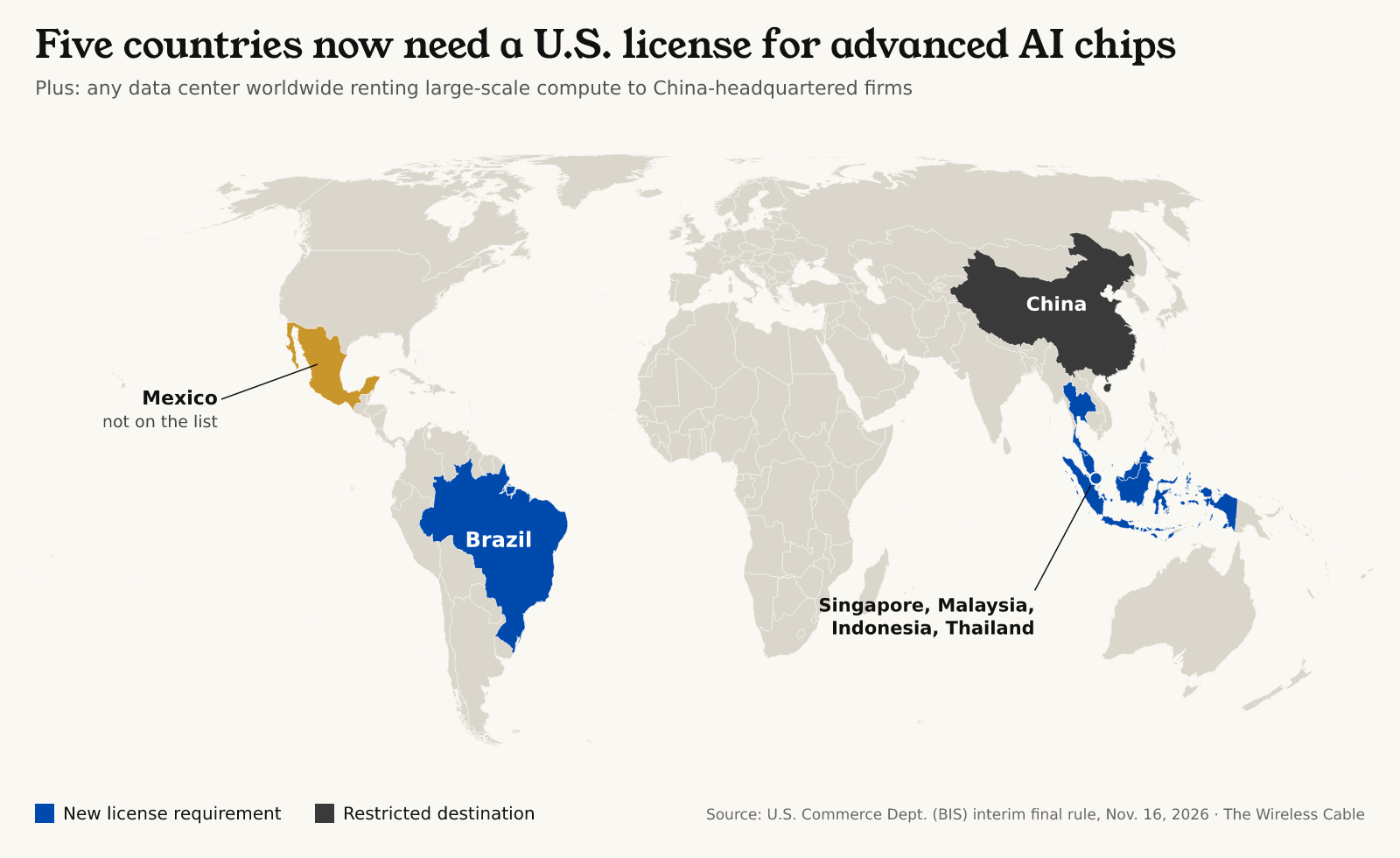
Five countries now need a U.S. license for advanced AI chips under the Commerce Department’s November 16 rule. Mexico, a key link in Nvidia’s supply chain, isn’t on the list. Map: The Wireless Cable, based on the BIS interim final rule.
Mexico isn't on the list, and that's worth a second look. Mexico sits deeper inside Nvidia's supply chain than most people realize:
Foxconn's Mexican operations build racks using Nvidia's Blackwell architecture, including the GB200 NVL72 system.
Makers of data center equipment in Chihuahua, Jalisco, Nuevo León, Tijuana and Querétaro exported over $37 billion in the first quarter of 2026 alone, per Banxico.
Nvidia is bringing its Cloud Partners model to Mexico City and Querétaro, and its regional director said those centers won't only serve Mexican demand.
At the same time, President Sheinbaum has said Mexico needs data centers but shouldn't become a data center for other countries, citing energy and water. That was an environmental argument. After today, it's also a geopolitical one: hosting compute for foreign customers now comes with compliance obligations written in Washington.
What to watch
Tomorrow's earnings call. Nvidia reports third-quarter results on Tuesday, November 17, its first with Colette Kress as interim CEO. Expect questions on how much revenue runs through the five newly listed countries.
The fine print. The rule takes effect on publication in the Federal Register, with comments due 60 days later. Data centers serving Chinese clients then have 90 days to obtain a license.
Congress. Several bills are moving, and some were folded into this year's NDAA, according to Fortune. The Remote Access Security Act would codify today's rule into law (the House passed it in January); the Chip Security Act would require location tracking on advanced chips; and the AI Overwatch Act would allow Congress to block chip sales to adversaries, treating chips more like weapons.
Commerce itself. Secretary Howard Lutnick is under pressure over why Chinese companies were cleared to handle Nvidia chips despite warnings from intelligence agencies. Axios reports that Trump authorized a crackdown on chip diversion three times this year while Lutnick stalled.
TWC Insight
The rule tells us where the AI race is actually being fought. The chip is a commodity Nvidia makes by the million. The scarce thing is access to large, linked clusters of them, and access runs through accounts, contracts and logins. Washington has started treating compute the way it treats territory: who controls it, who can enter, and under whose rules.
The scandal also says something uncomfortable about how that territory was guarded. For years, the de facto gatekeeper was a single company, run by a single executive with 60 direct reports and no COO, who openly opposed the controls. When a relationship compromised that gatekeeper, the state stepped in with an interim rule four days after his resignation. That's what happens when private infrastructure carries the weight of public security without public oversight.
For countries hosting compute, the lesson is that trust gets priced in. Brazil now pays for its place on the list in licenses and delays. Mexico is in a stronger position: it has been a member of the Wassenaar Arrangement on export controls since January 2012, it sits within the USMCA, and its data center boom is largely built by U.S. hyperscalers that qualify for the carve-out. Mexico's own export control law already exempts exports to fellow Wassenaar members from licensing requirements, so the institutional basis exists; what it doesn't cover yet is remote access to computing resources. That advantage is fragile. If Nvidia Cloud Partners in Querétaro start serving clients whose ultimate parents nobody checked, Mexico's name can end up in the next interim final rule. The smart move is to get ahead of it: a national know-your-customer standard for large compute providers, written in Mexico City before someone writes it in Washington.
Takeaway
Export controls now follow the login, wherever the chip happens to sit. Whoever hosts the compute will be asked who is using it, and countries that can answer that question themselves will keep their seat at the table.
Cover photo by Manuel on Unsplash.
